Factory Office Interior Design for a Ceramic Tile Factory in Dubai
A factory office has to support a very different working environment from a standard commercial workplace. It sits between production, management, client communication, product development, logistics, technical coordination, and daily administration. The interior must therefore provide comfortable working conditions while maintaining a clear relationship with the products manufactured nearby.
For this factory office interior design project in Dubai, our aim was to create a workplace for a ceramic tile manufacturer that expressed the company’s production identity through the interior itself.. Ceramic patterns, color references, modular surfaces, sample-display areas, transparent meeting spaces, and practical storage were incorporated into the architecture rather than treated as separate decorative additions.
The completed office functions as a working environment, an informal client lounge, a meeting area, and a compact presentation space for the factory’s ceramic capabilities. Visitors can immediately understand the nature of the business through the materials, colors, patterns, and construction details surrounding them.
Understanding the Requirements of Factory Office Interior Design
Part of our office interior design service is understanding the specific requirements of each project we work on. A factory office usually has to serve several groups of people during the same working day. Management teams require focused work areas and meeting rooms. Production staff may need quick access to managers, drawings, schedules, samples, and technical information. Clients and consultants may visit to inspect products, approve colors, discuss custom patterns, or review project requirements.
The office must therefore create a professional atmosphere without becoming disconnected from the production facility.
In a ceramic tile factory, the relationship between the small office and the product is particularly important. Tiles are highly visual and tactile products. Their appearance changes according to scale, grout color, lighting, installation direction, surrounding finishes, and the distance from which they are viewed.
A small tile sample can communicate color and texture, but it cannot always show how a pattern will work over a large area. For that reason, we incorporated ceramic-inspired surfaces at architectural scale. This allowed the office to become part of the product-presentation process.
The design was planned around several central requirements:
- A welcoming area for visitors and informal discussions
- A private meeting room close to the reception lounge
- Large surfaces for presenting pattern and color
- Practical storage for samples and documents
- Durable materials suitable for a factory-related workplace
- Clear circulation between client-facing and staff areas
- A design identity connected directly to ceramic production
- A balance between expressive product displays and comfortable daily use
A Product-Based Interior Concept
The main design concept was based on two sides of ceramic manufacturing: decorative pattern and controlled color production.
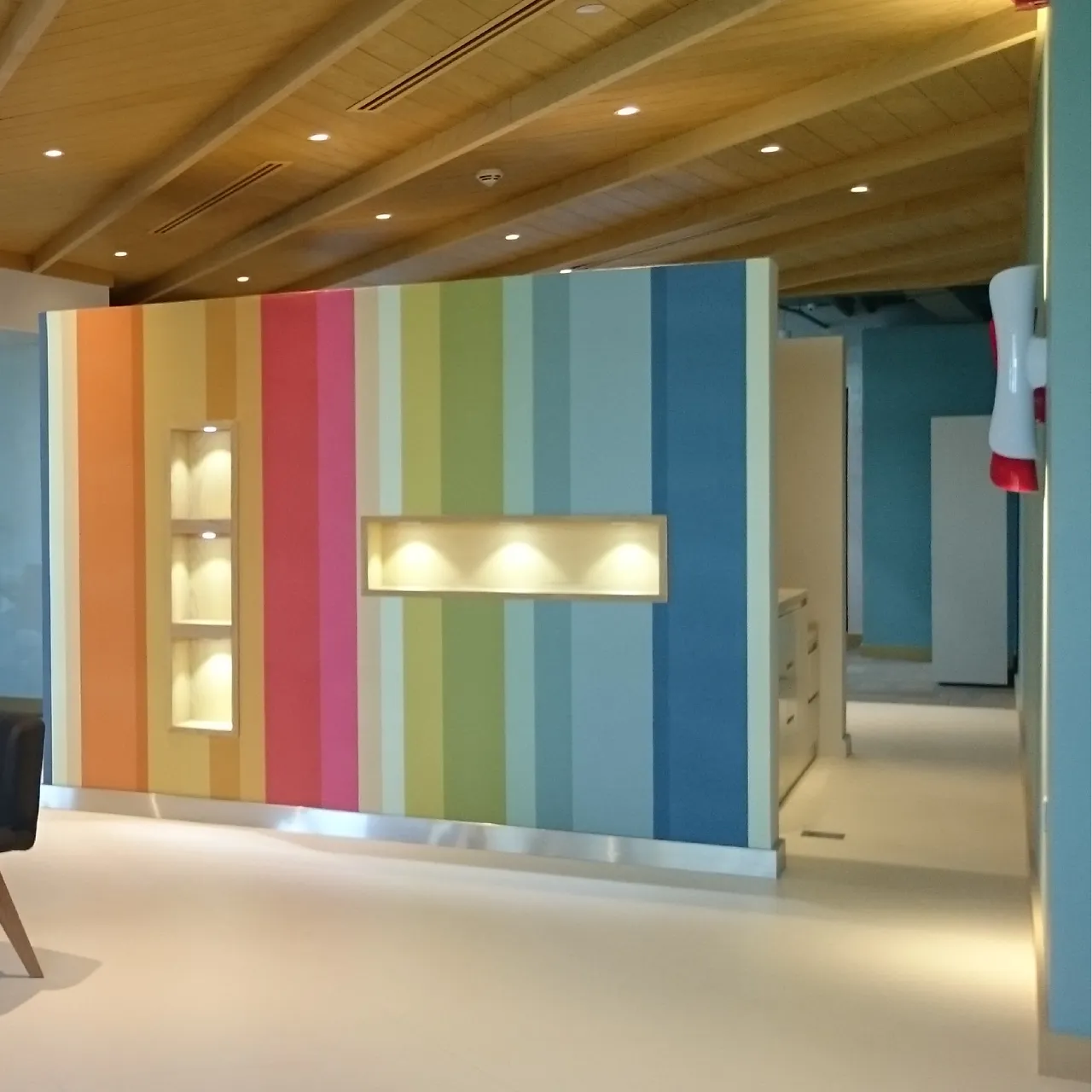
For this small factory office design, we planned to use two major feature walls. The first features a large, irregular composition made up of many decorative patterns. The second uses vertical bands of color, progressing from warm oranges and yellows to pinks, greens, pale blues, and deeper shades of blue.
These two walls have very different visual characters, but they support the same purpose. They show the factory’s ability to work with decorative surfaces, graphic patterns, color development, modular composition, and custom finishes.
The patterned wall communicates craftsmanship, ornament, cultural references, printing, and composition. The striped wall communicates color control, variation, system, repetition, and contemporary production.
By placing these walls within the main visitor area, we turned the company’s product knowledge into part of the architecture.
The office does not depend heavily on logos, posters, or conventional corporate graphics. The ceramic language itself becomes the identity of the space.
Planning the Client-Facing Area
In this small factory office design, the main client area is arranged as an open lounge rather than a formal reception room. This choice supports the type of conversations that often take place in a factory office.
Clients may need to sit with drawings, compare samples, review finishes, or discuss technical options. A typical row of waiting chairs would not provide the same flexibility.
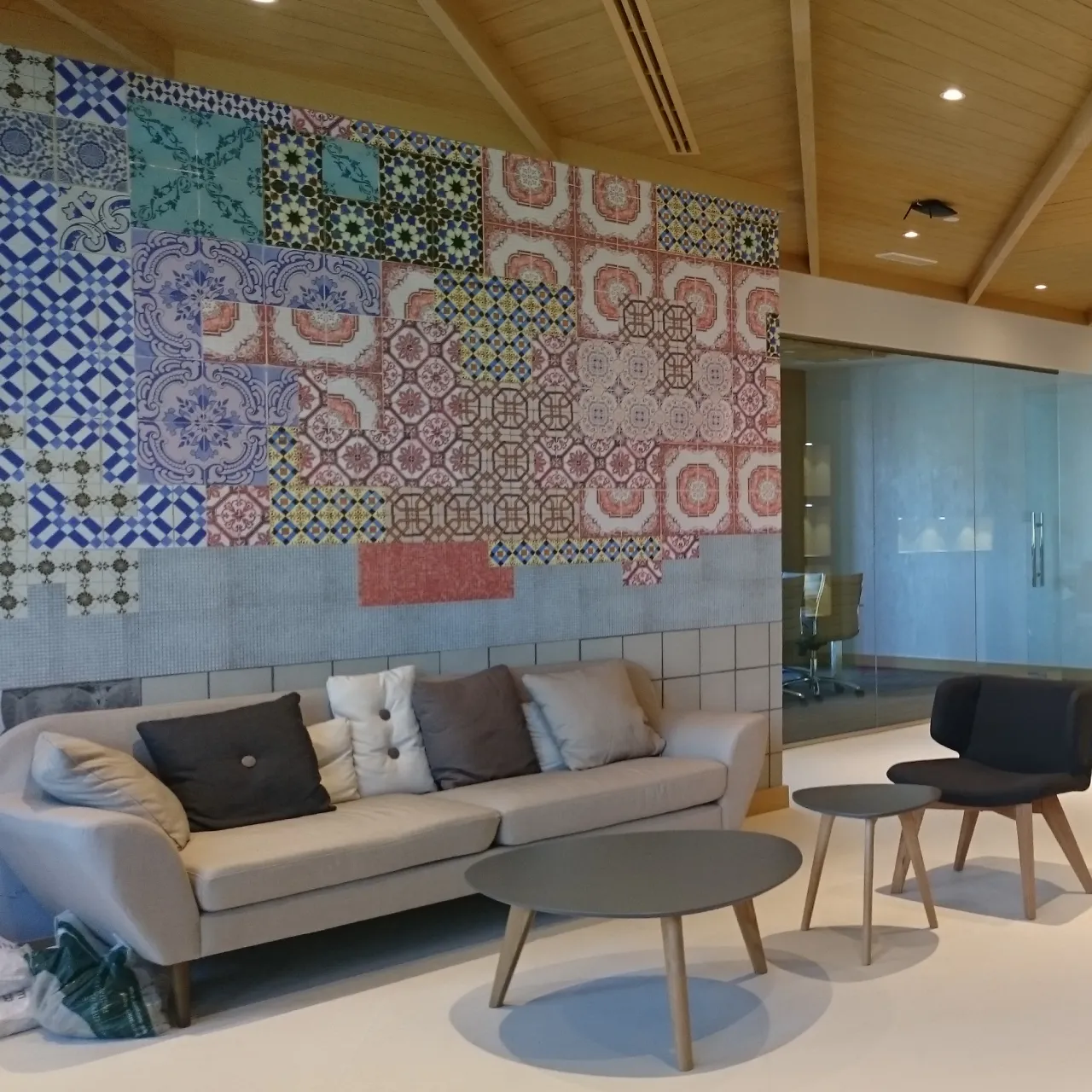
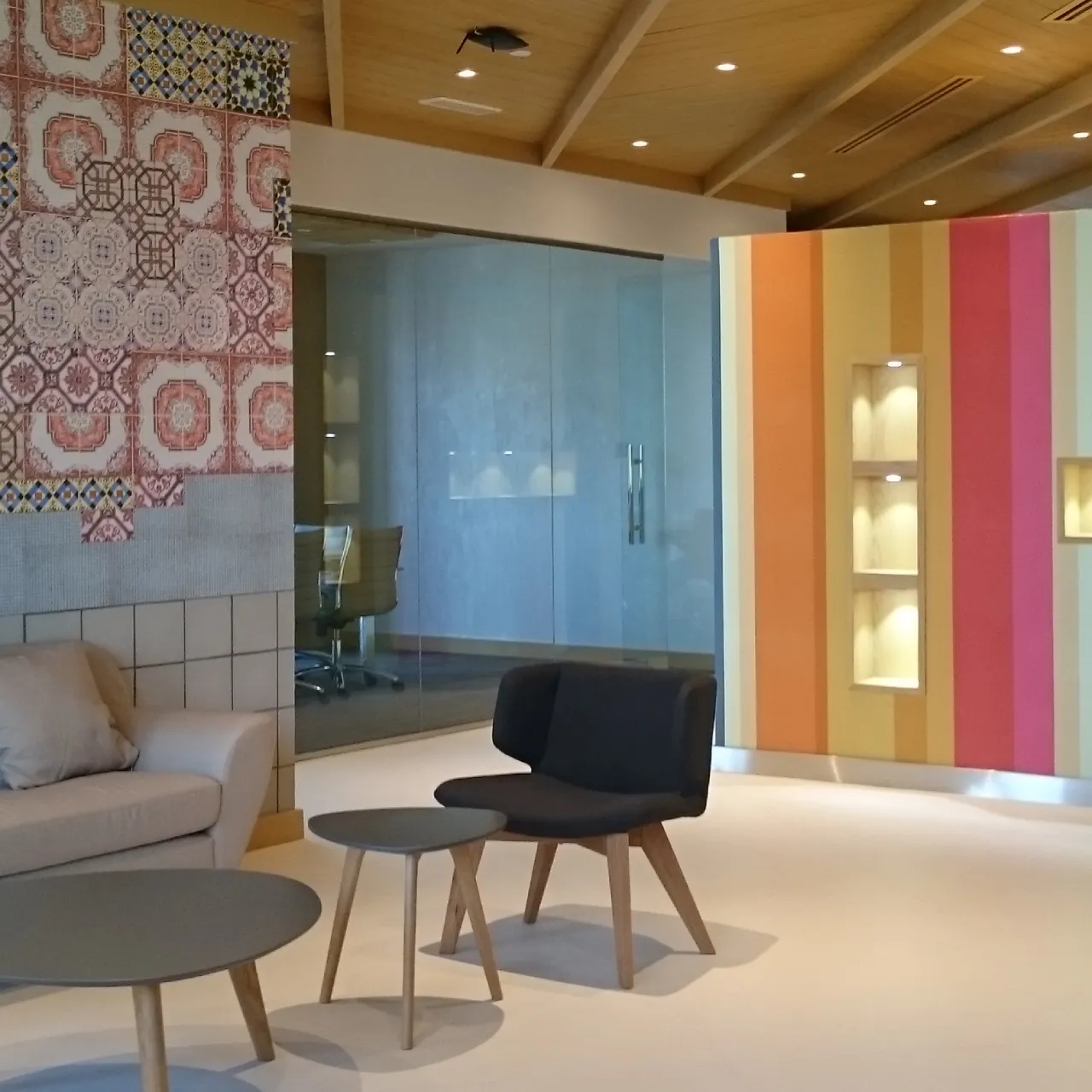
The lounge includes a three-seat sofa, a separate upholstered chair, and two low tables. The furniture is positioned to allow comfortable conversation while keeping the feature walls visible.
The arrangement allows several meeting formats:
- A short introductory discussion
- An informal presentation with two or three visitors
- A product review using small samples
- A conversation before entering the meeting room
- A waiting area for contractors, suppliers, or consultants
- A secondary discussion space when the formal meeting room is occupied
The furniture remains low so that it does not block views through the office. This is especially important because the project has a high pitched ceiling and large display surfaces. Tall furniture would have interrupted the visual connection between the lounge, meeting room, and color wall.
Creating an Informal Reception Lounge
The sofa was selected in a light neutral upholstery to provide visual relief beneath the detailed ceramic wall. A highly patterned or colorful sofa would have competed with the tile composition and made the area feel too active.
The neutral upholstery also creates a suitable background for meetings where ceramic samples may be placed on the seating or tables. Product colors can be assessed without strong furniture colors affecting their appearance.
The cushions introduce several related shades, including off-white, pale grey, taupe, charcoal, and soft beige. These tones connect the sofa with the grey tables, dark lounge chair, pale floor, and timber ceiling.
A charcoal lounge chair sits at an angle opposite the sofa. Its dark fabric provides visual weight within an otherwise light seating arrangement. Timber legs connect the chair to the warm ceiling finish, while its dark upholstery relates to the coffee tables and deeper cushion tones.
The chair’s position also allows the user to view both feature walls. During a discussion, a member of staff can refer to the patterned tile display or the color installation without moving to another part of the office.
Designing the Decorative Ceramic Feature Wall
The large wall behind the sofa forms the main product-related statement within the small office.
Instead of covering the surface with one repeated tile, we created a large patchwork composition using multiple decorative motifs, colors, and scales. The wall includes geometric patterns, floral medallions, checks, stars, diamonds, interlocking linework, ornamental frames, and repeated border elements.
The color range includes blue, white, teal, green, yellow, terracotta, dusty pink, brown, grey, and soft neutral tones.
Some of the patterns refer to Mediterranean, Spanish, Portuguese, North African, Islamic, and traditional European decorative influences. This varied visual language is suitable for a Dubai-based manufacturer working with clients from different regions and with projects that may require traditional, transitional, contemporary, or custom-designed surfaces.
The wall demonstrates that ceramic design can respond to many architectural directions rather than being limited to one visual style.
Breaking Away from a Standard Tile Grid
A regular tile installation usually follows a complete rectangular grid. For this wall, we used an irregular composition with sections that project, stop, shift, and overlap visually.
The installation resembles a large material-development board. Individual groups of tiles appear to have been arranged, tested, compared, and extended over time.
This approach has several advantages.
First, each pattern remains visible as an individual product or design family. If the entire wall had used one repeated motif, it would have shown scale but not product range.
Second, the irregular outline adds movement. The eye travels from one group of tiles to another rather than reading the wall as one flat repeated surface.
Third, the open edges reveal the grey background and make the composition feel lighter. A completely covered wall containing the same number of patterns could have felt visually heavy.
The installation also reflects the experimental side of ceramic development. Factories frequently work with test prints, glaze samples, prototype patterns, alternate color combinations, and sample runs. The wall suggests that process without attempting to recreate a production area literally.
A Stable Base Beneath the Decorative Wall
The lower section of the feature wall uses simpler materials and a clearer modular structure.
A wide grey textured band sits beneath the main decorative composition. Below it, pale rectangular units are arranged in a regular grid with visible dark joints.
This lower section gives the feature wall a stable visual base. It also demonstrates another aspect of ceramic installation: the relationship between unit size, joint width, alignment, and grout contrast.
The visible joints emphasize the modular nature of the wall. Ceramic tiles are individual units that form a larger surface through repetition and careful alignment. By making the joints clear, the design acknowledges this construction logic instead of hiding it.
The simpler lower area also protects the detailed composition from direct contact with the sofa and cushions. Decorative patterns remain concentrated at eye level, where visitors can view them comfortably.
The Color Bands Wall Design
The vertical bands are not all the same width. Some colors form broad panels, while others appear as narrow separators.
This variation prevents the wall from looking like standard striped wallpaper. It gives the surface a more architectural composition and creates a controlled sequence of broad and narrow intervals.
The lighter strips help separate stronger colors. Cream, pale green, and soft neutral bands reduce direct contact between highly saturated oranges, pinks, greens, and blues.
The changing widths also relate indirectly to ceramic formats. Tile collections often include multiple module sizes, trims, borders, and decorative inserts. The wall converts that modular variety into a large graphic installation.
the Glass Meeting Room
A glass-enclosed meeting room sits between the patterned wall and the color installation.
This central placement allows the meeting room to act as a visual pause between two expressive surfaces. The transparency of the enclosure keeps the office connected and allows the timber ceiling to remain visible through the glass.
A solid meeting-room wall would have divided the interior into smaller sections and reduced the sense of space. Full-height glass maintains long sightlines from the lounge toward the back office.
The meeting room is close enough to the reception area for visitors to move directly from an informal conversation into a formal presentation or technical discussion.
This supports a natural working sequence:
- Visitors arrive and sit in the lounge.
- Initial requirements are discussed informally.
- Patterns and colors can be viewed in the reception area.
- The discussion moves into the meeting room for drawings, specifications, pricing, or approvals.
- Staff can then access samples or documents from the nearby storage areas.
Selecting Durable Materials Without Making the Office Feel Industrial
Durability is central to factory office design, but durable materials do not have to create a harsh environment.
The project combines hard-wearing finishes with softer residential-scale furniture. Ceramic surfaces and metal bases can tolerate frequent contact and cleaning. Glass partitions are practical and visually open. Light flooring supports daily maintenance.
At the same time, the sofa, cushions, lounge chair, carpet, and timber ceiling create comfort.
This balance is important because clients may spend a significant amount of time in the office reviewing products or discussing custom orders. The space should feel professional and connected to production, but it should also support long conversations.
Keeping Corporate Identity Connected to the Actual Product
Many commercial interiors apply corporate colors to walls or furniture without showing what the company actually produces.
For this project, we used ceramic design itself as the foundation of the identity.
The feature walls communicate product variety, color capability, pattern development, and installation possibilities. The niches can support changing sample displays. The modular compositions relate directly to the manufacturing process.
This creates a stronger connection between the workplace and the company’s daily work.
The office can also change over time. New samples can be placed in the niches, product groups can be updated, and selected wall sections can potentially be used to present future collections.
Allowing the Office to Work as a Small Showroom
The project does not use the typical layout of a large tile showroom with rows of sliding panels and numerous display bays. Instead, it incorporates selected product references into the office architecture.
This approach is suitable where the office must remain primarily a workplace but also support client presentations.
The product displays are concentrated in a few major elements rather than spread throughout every wall. This gives the factory office interior design a clear identity without turning every surface into a sample rack.
It also leaves room for staff functions, storage, circulation, and meetings.
The Completed Factory Office
The completed factory office interior design brings together workplace planning, product presentation, meeting functions, material storage, and corporate identity.
The decorative wall shows the expressive potential of ceramic pattern. The color wall presents tone, sequence, and production range. The meeting room provides a professional setting for detailed discussions. The lounge supports informal communication. The timber ceiling unifies the office and softens the harder materials.
The project demonstrates how factory office design can remain practical while maintaining a close connection with manufacturing.
Rather than creating a generic administrative interior beside the production facility, we developed an environment that reflects what the company makes, how it works, and how it communicates with clients.
Every main area contributes to that purpose. The walls present ceramic possibilities. The lounge supports discussion. The meeting room supports decisions. The storage areas keep samples close to the people who use them. The lighting helps materials remain visible. The durable finishes respond to daily factory operations.
The result is a distinctive ceramic factory office in Dubai where product, architecture, and workplace function form one connected interior.