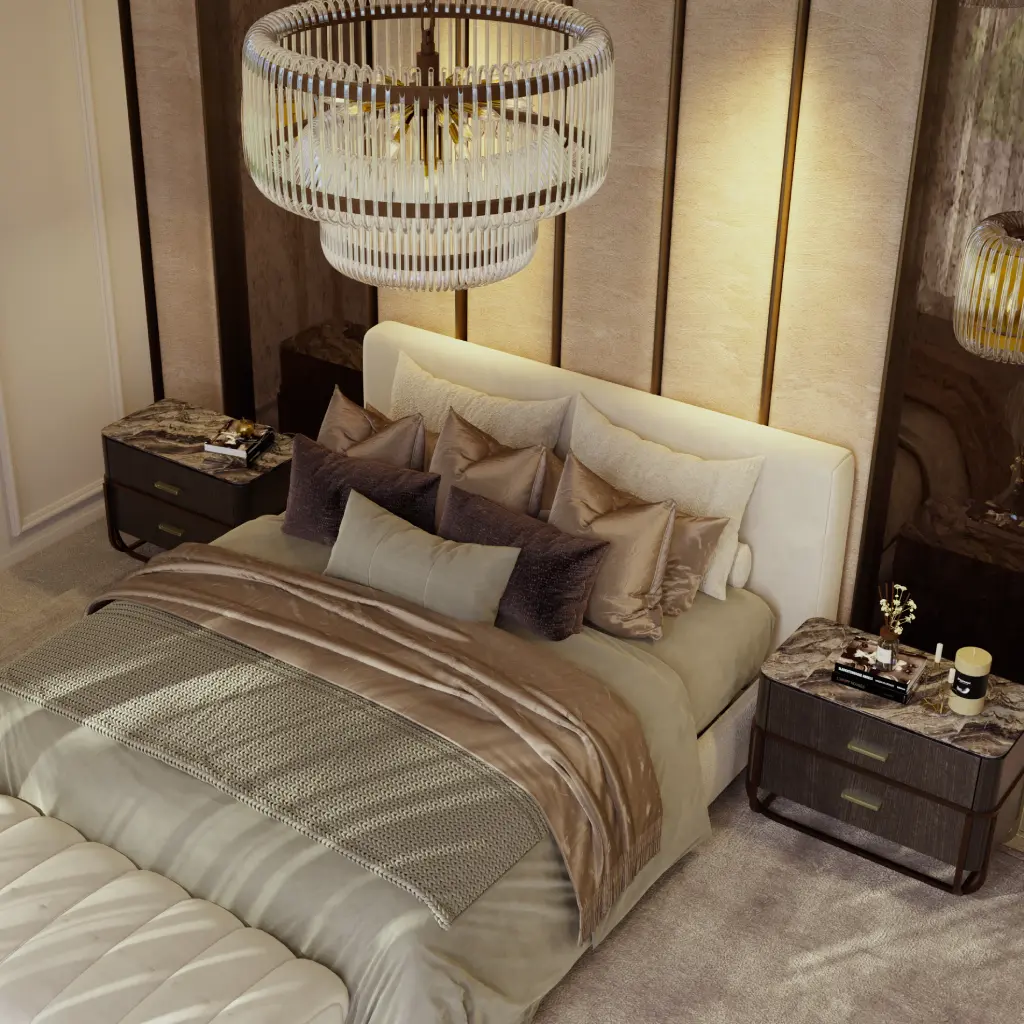
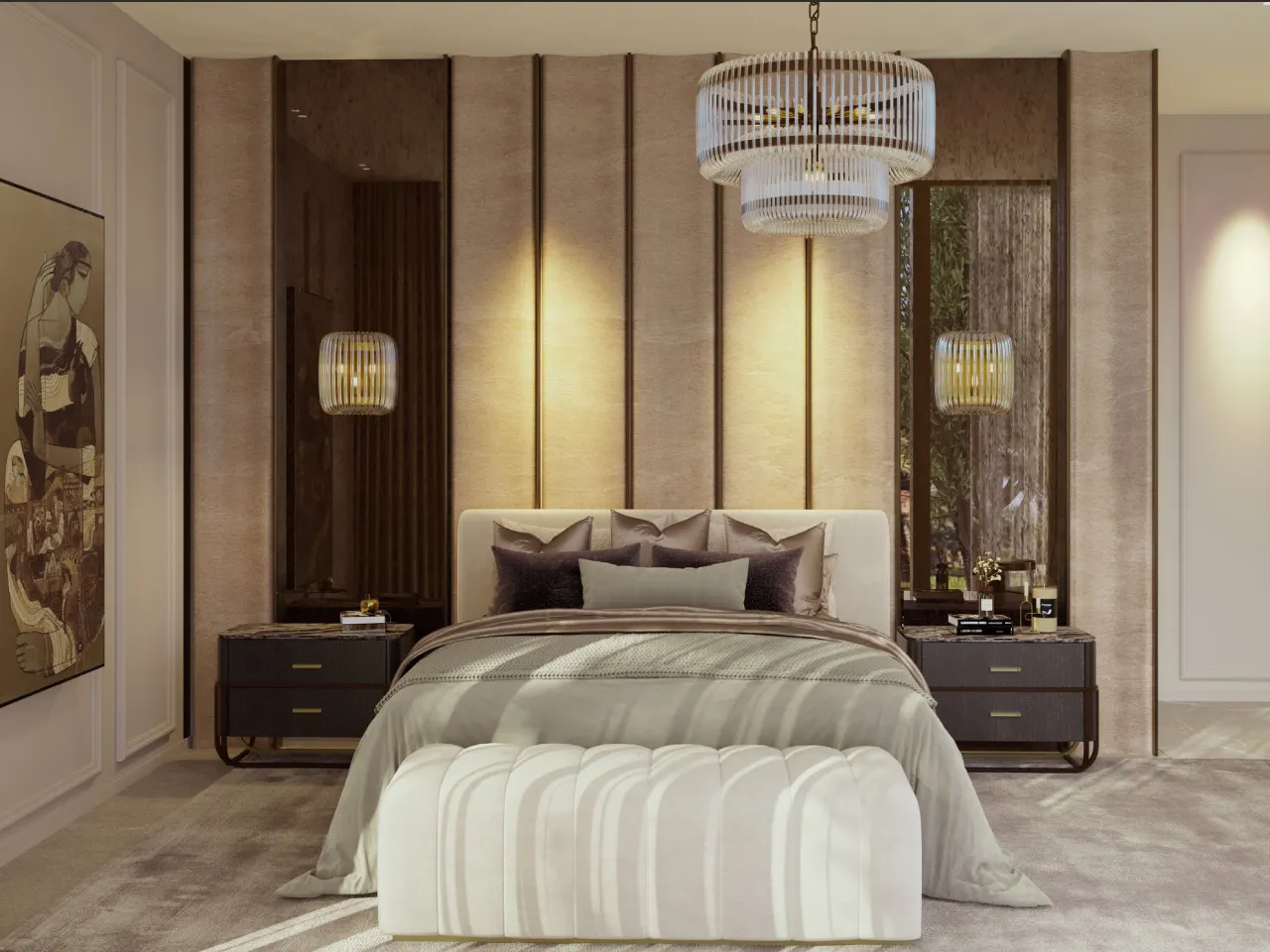
Here, you can see a master bedroom interior design we have done for one of our projects in Dubai. Our design approach to this interior design was to build it around a relationship: plush, tactile comfort held inside a firm architectural order. That decision shaped every layer of the room, from the headboard wall to the chandelier, from the bench to the window drapery. The result is a bedroom that feels warm and personal, yet still carries the ceremony expected in a primary suite.
The Bed Wall as Interior Architecture
The starting point here is the wall behind the bed. Instead of treating it as a background waiting for art, we treated it as built interior architecture. Tall upholstered-looking fields, slim dark divisions, and glossy outer panels turn the bed zone into a contained spatial setting rather than a furniture grouping placed against gypsum board. This move changes the status of the bed immediately. It feels nested into the room, not simply positioned in front of it. That is one of the main reasons the project carries depth without relying on ornament.
What makes this wall look stylish is its balance of softness and structure. The padded central panels keep the composition tactile and inviting, while the darker polished fields at the edges bring gravity and reflection. If the entire wall had been soft, the room could have drifted into tonal blur. If the entire wall had been dark and reflective, it would have turned heavy. The value comes from the tension between matte and sheen, softness and density, warmth and shadow.
Vertical Rhythm as the Unifying Design Language
A second layer of the master bedroom design project is vertical rhythm. Nearly every major element participates in it. The wall composition rises in tall bands. The pendants beside the bed drop as vertical markers. The chandelier is made of slim ribbed elements rather than a solid mass. The bench carries broad channeling. Even the drapery falls in long folds that continue the same movement. This gives the room a family language without forcing exact repetition. The forms are related, but each one speaks through its own material: upholstery, glass, metal, paneling, textile. That is where cohesion becomes felt rather than announced.
Where this rhythm appears
- the headboard wall panels
- the pendant lighting
- the chandelier structure
- the bench channeling
- the drapery folds
Lighting That Shapes the Room
Lighting was used here as a shaping tool, not as an accessory. The warm vertical illumination behind the bed does much more than add mood. It separates the headboard from the wall, gives body to the cream and taupe palette, and ensures the room keeps atmosphere after sunset. That matters in a bedroom of this type. A suite should not depend on daylight to feel complete. It needs its own evening identity, and the hidden warm glow behind the bed gives it exactly that.
The suspended bedside pendants are equally important. By removing table lamps, we kept the nightstands open and useful, which immediately gives the room a cleaner, more resolved bedside condition. At the same time, the pendants pull the eye upward and tighten the frame around the bed. They work almost like markers in a ceremonial composition: close enough to intensify the center, subtle enough not to overpower it.
A Bedroom That Works as a Suite
A bedroom is not only a sleep setting. The lounge chair near the window and the small side table push the bedroom into suite territory. They create a second zone for reading, pausing, or simply occupying daylight. This keeps the room from becoming a single frontal composition and allows it to work from multiple positions. Head-on, the bedroom has order and presence. From an angle, it has depth, softness, and a more intimate sense of use. A resolved interior needs both.
Luxury Through Details
What gives the project its luxury is not abundance. It is editing the details. There are few objects, but each one carries real visual work: the architectural bed wall, the open chandelier, the pendant frame, the tactile bench, the glossy dark panels, the low-contrast carpet, the full-height drapery. Nothing was added to fill space. Every material was given a role.
Material roles in the project
- Upholstery carries bodily comfort.
- Glossy panels carry depth.
- Stone tops mark touch points.
- Metal provides warm punctuation.
- Carpet softens the base.
- Drapery softens the perimeter.
Final Reading
This bedroom interior design is gentle, warm and formal. That balance is what gives the room its lasting quality. Luxury here comes from composition, restraint, and the precise way softness is held inside structure.