In villa interior design projects in Dubai, we developed the interior design scheme through a careful calibration of luxurious details rather than the accumulation of too many elements. This approach depends on how one surface meets another, how a large volume is moderated, how softness is given structure, how daylight is absorbed by warm materials, and how one bold move is strengthened by a nearby moment of restraint.
That idea shaped the entire villa’s living-dining interior. The space carries a contemporary villa language, yet it keeps a faint classical echo in its ceiling line, proportion, and furniture posture. There is also a slight art-deco note in the metal trims, the rhythmic shelving, and the chandelier geometry. None of those references are pushed too far. Instead, they sit inside a tightly edited palette of cream upholstery, warm beige stone, bronze-gold metal, dark wood, smoked accents, and richly veined brown stone.
What makes the result persuasive is not the cost of the elements in isolation. It is the way the interior design holds opposites in balance. The architecture is tall, crisp, and highly composed. The furniture is soft, rounded, and inviting. The palette is pale, yet it never feels washed out. The room is formal, but movement through it remains generous. The interior has presence, but it still leaves space for daylight, garden views, and daily use.
Luxury villa design works well when every rich gesture is paired with restraint.
Two systems hold the space together
From the start, we treated the room as a meeting point between two different systems.
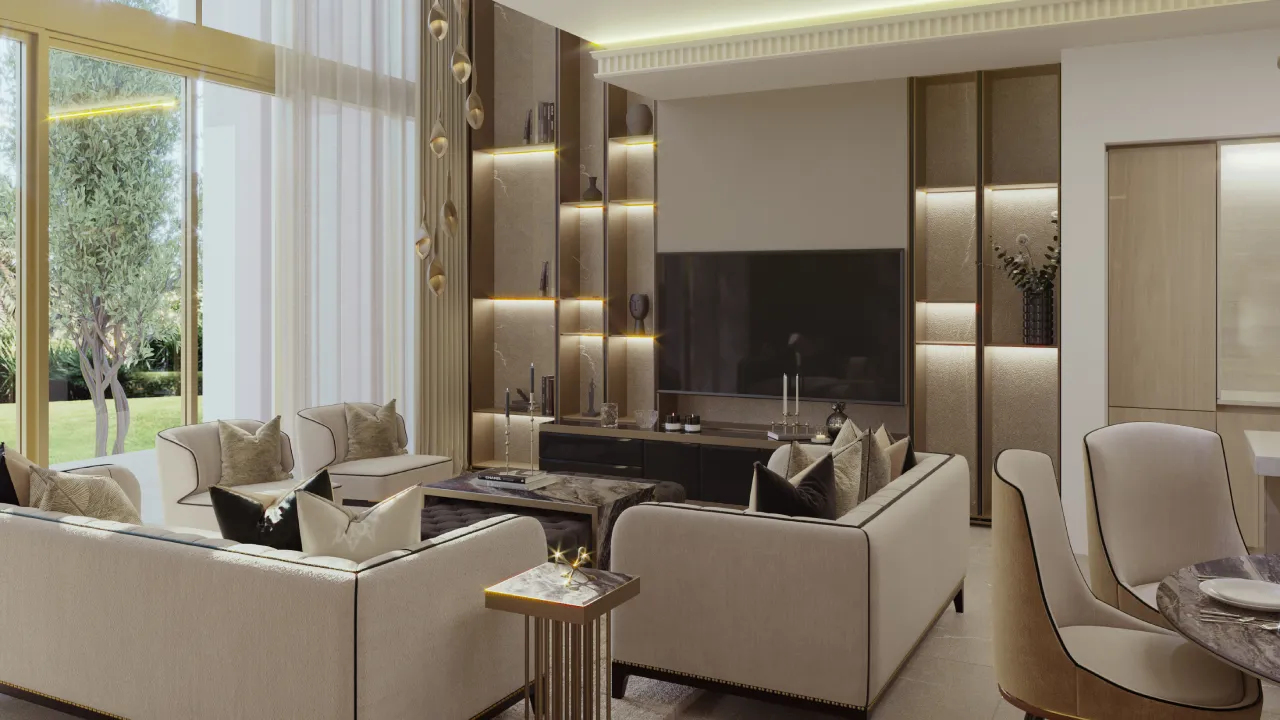
- The first is architectural. It includes the tall media wall, vertical shelving bands, textured panel infill, concealed warm lighting, broad glazing, a fluted ceiling band, and perimeter cove light. These elements give the living room its stature. They define the villa scale and establish order.
- The second is furniture-led. It includes curved sofa arms, upholstered lounge chairs, tufted ottomans, layered cushions, sheer curtains, and a pale area rug. These elements soften the shell and pull the room back toward comfort.
The success of the interior design project comes from keeping both systems active at the same time. If the room leaned only on architecture, it would feel severe. If it leaned only on soft upholstery and pale fabric, it would lose authority. The interior design gains character from the friction between those modes.
That is why the sofas have rounded forms but clear piping. That is why the chairs are gentle in shape yet still carry a formal posture. That is why the stone coffee table looks substantial but is lifted by a slim bronze frame. Softness is always given an outline. Weight is always given relief.
In large residential interior designs, this balance matters more than in smaller apartment interior designs. Villas have the volume to absorb large gestures, but they also need intimacy. The room has to welcome conversation at human scale while still belonging to the wider architecture. Holding both conditions at once is where much of the design work happens.
The media wall is treated as architecture
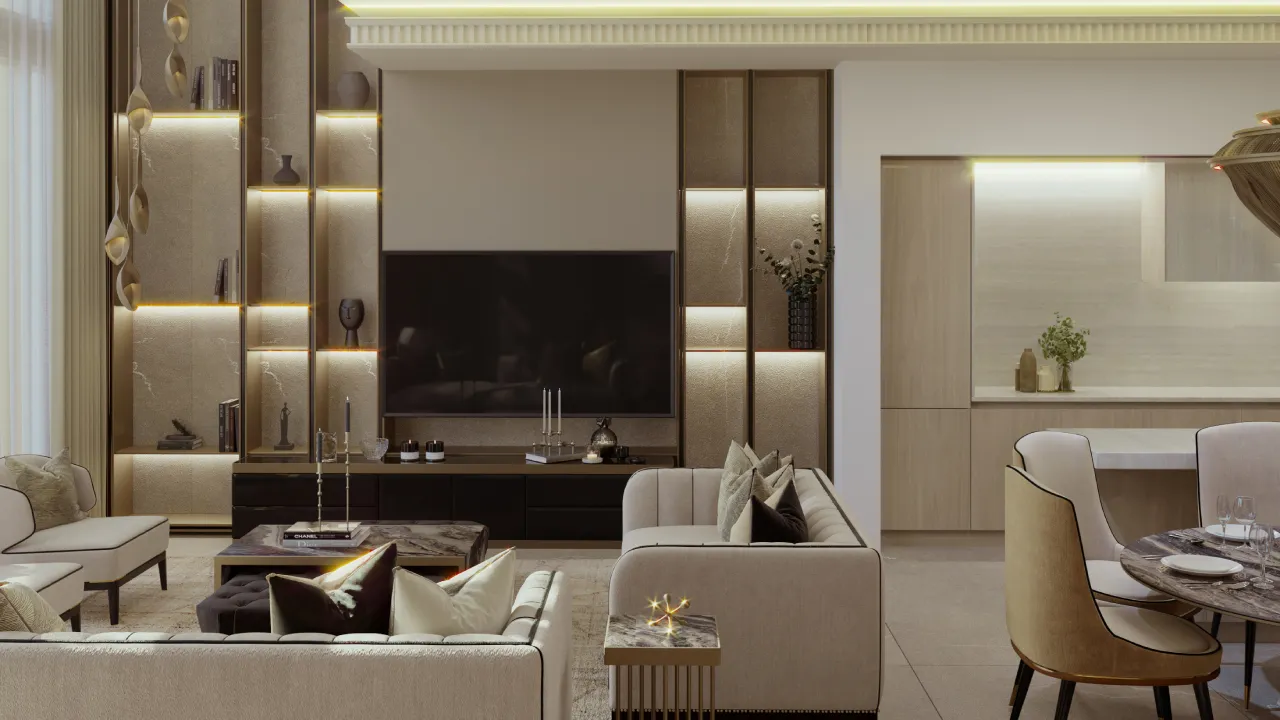
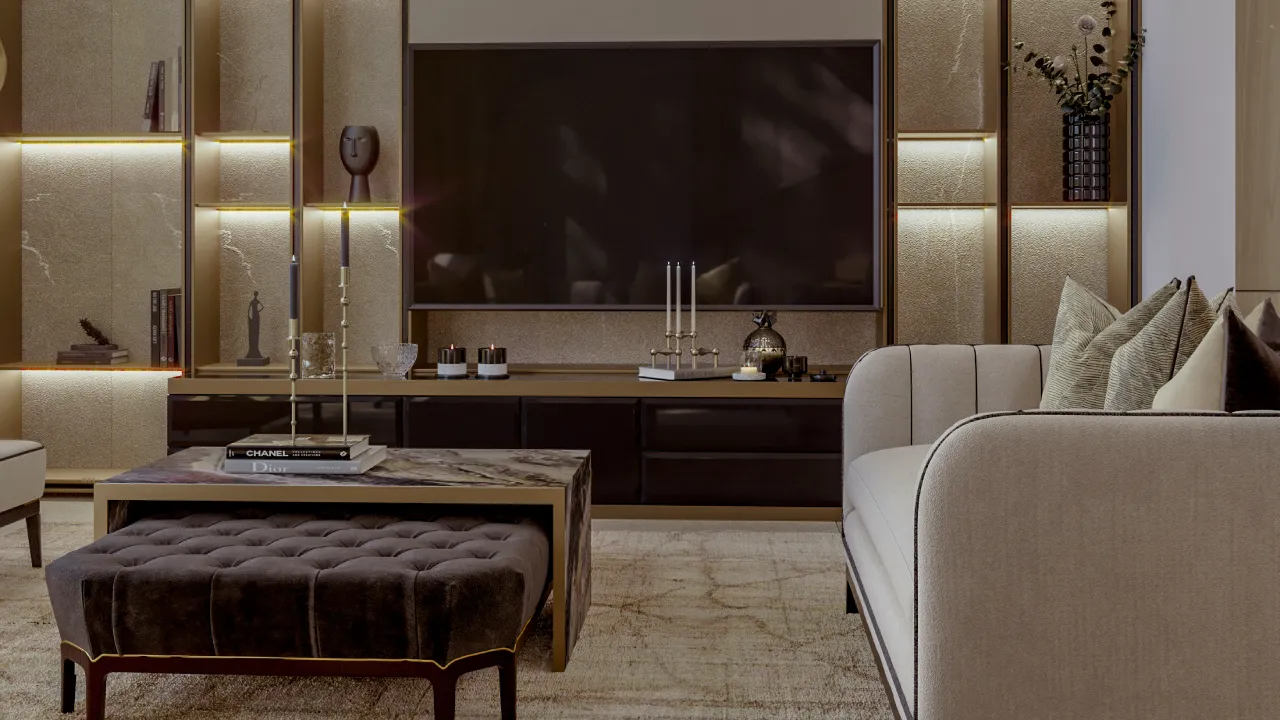
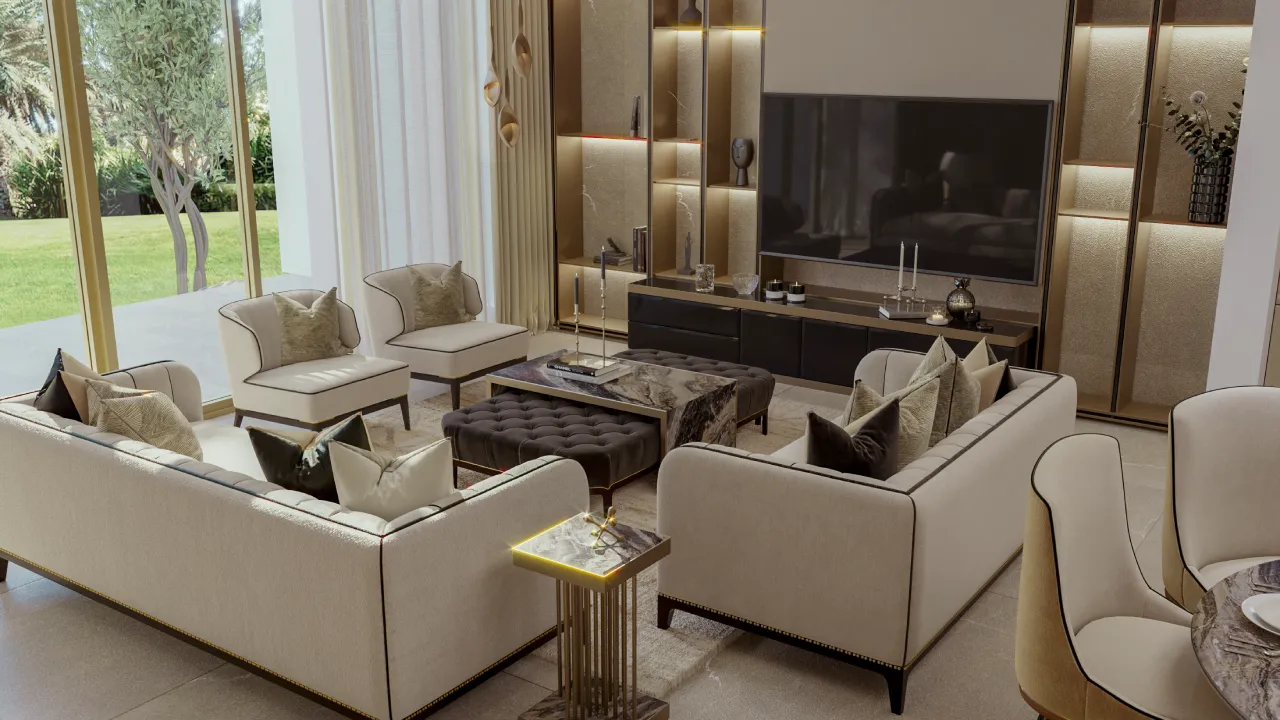
The television wall design was developed as a built architectural element. The screen sits within a disciplined composition of tall illuminated shelving, textured infill panels, bronze-toned borders, and a long low console in a deep wood tone. The TV is not applied to the room. It belongs to the room.
One of the refined decisions here is proportion. The screen is large, but it is held low. The empty wall field above it gives the composition air and keeps the screen grounded. Without that upper pause, the media wall would feel busy or overworked. With it, the shelving on either side becomes sharper, the television feels anchored, and the height of the room is registered without excess.
Lighting also plays a major role. The shelf illumination does not spill aggressively into the space. It washes the backs and undersides of the niches with a warm amber tone. That method brings out the surface texture of the infill panels and gives the shelving depth without harsh contrast. The wall therefore gains atmosphere through light rather than through color noise.
Below the screen, the long dark console performs an equally important role. The room contains many vertical forces: tall glazing, tall shelving, long drapery lines, and upright decorative elements. The console answers that vertical pull with a firm horizontal base. It widens the composition, lowers the visual center of gravity, and turns the television zone into a complete architectural unit.
Living Room Design Composition
At first glance, the seating arrangement seems straightforward: facing sofas, accent chairs by the glazing, a central table, and ottomans. In fact, the plan is doing careful work.
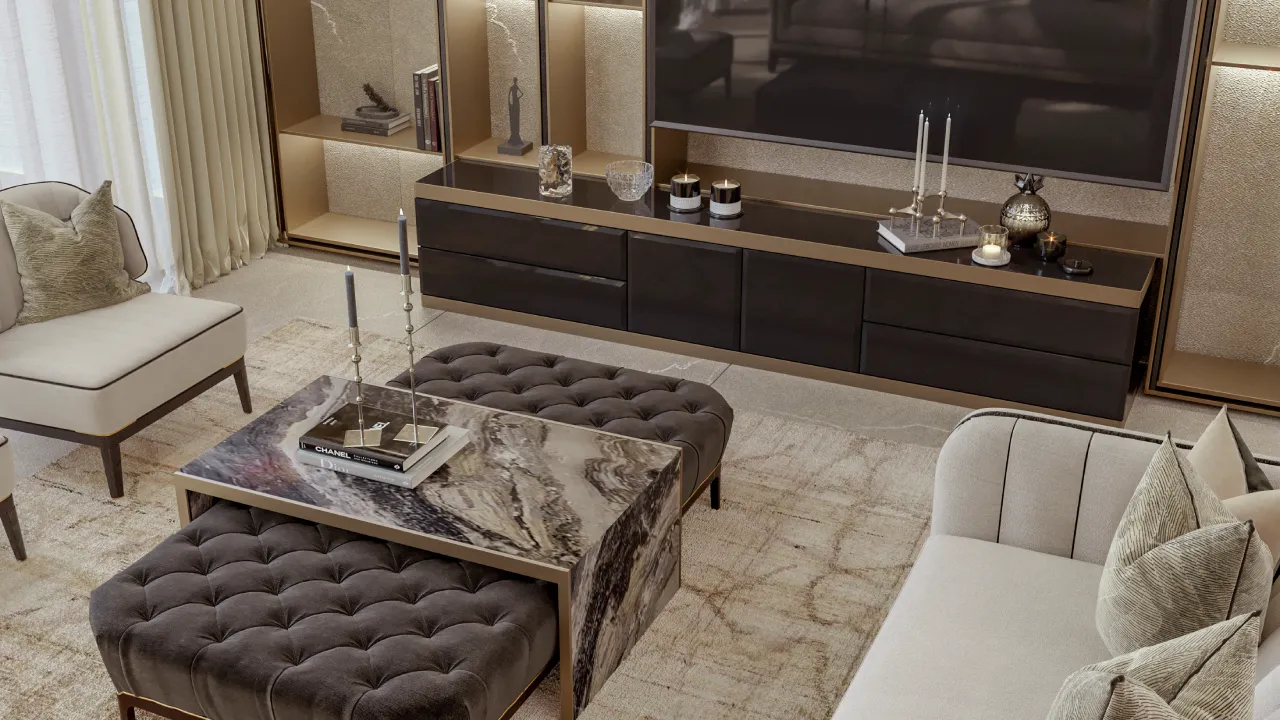
We organized the living area as a formal conversation island rather than a casual TV cluster. The sofas face one another, the lounge chairs reopen the composition toward daylight, and the central coffee table and ottoman grouping builds a dense middle. That center becomes the room’s visual ballast.
Cream upholstery, light stone flooring, and strong daylight can make a large room feel diffuse if there is no concentrated weight at the center. Here, the darker tufted ottomans, the veined stone coffee table, the bronze table frame, and selected darker cushions create a compact core. The middle of the arrangement absorbs mass and contrast, allowing the sofas and chairs around it to remain bright and generous.
The coffee table itself carries one of the project’s key material conversations. Its stone top and waterfall side display dramatic brown veining, which introduces movement and geological richness into an otherwise restrained palette. But that mass is lifted by a fine bronze-toned frame, so the table never feels blunt. Directly beside it, the dark ottomans add softness, texture, and a lower visual register. Hard stone and compressed upholstery sit next to each other, and each improves the other.
That tension is central to the room’s identity. Luxury here does not come from one heroic object. It comes from carefully staged contrasts: dense against light, polished against plush, stone against fabric, outline against curve.
Open-plan villa interiors need hierarchy
Because the living room is part of a broader open-plan space, it could not be designed in isolation. The dining zone, glazing wall, and kitchen edge all had to participate in one coherent interior language. At the same time, not every part of the room should speak at the same volume.
In this project, the living area takes the lead, and the adjacent zones support that hierarchy.
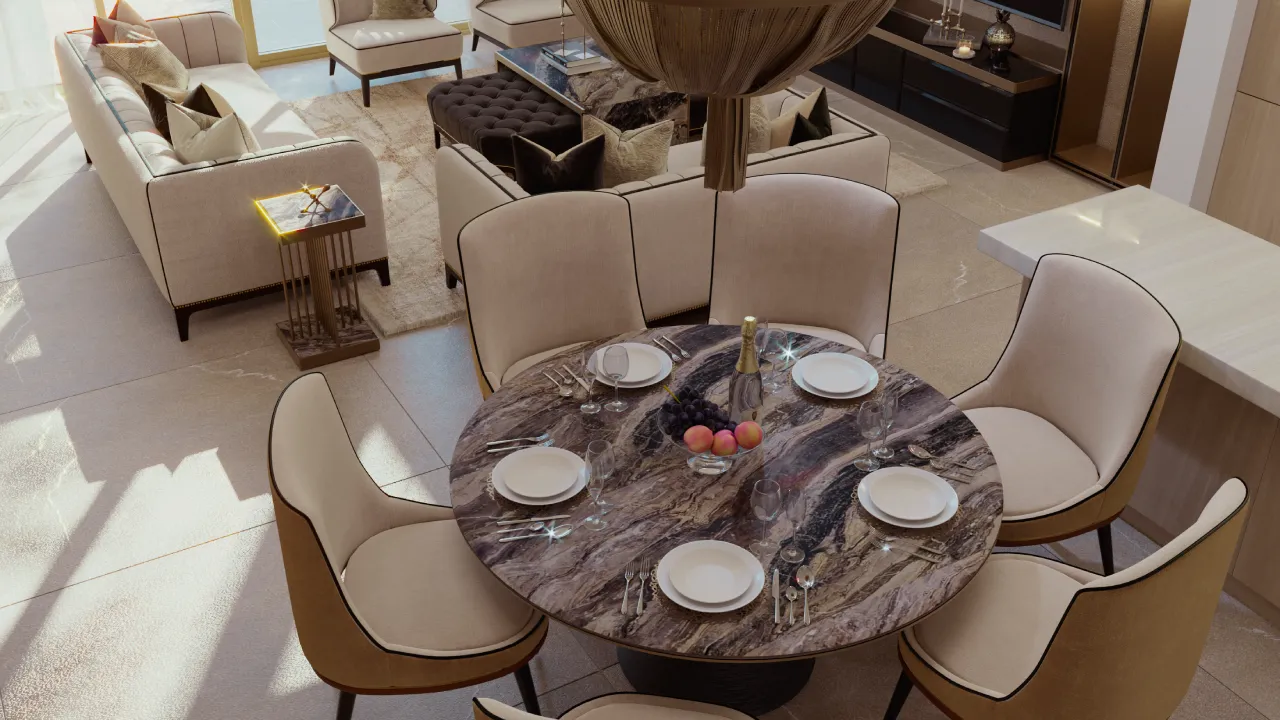
The dining table repeats the same veined stone family used in the coffee table. That repetition ties the open plan together without forcing sameness. The dining chairs bridge two material worlds at once: their inner faces stay close to the pale living upholstery, while their outer shells move closer to the warmer and darker wood-metal notes in the room. They act as translators within the plan.
Above the table, the chandelier is intentionally large and visually dense. In a room with significant ceiling height and a full glazed wall, a smaller fitting would have disappeared. Here the chandelier compresses the vertical volume above the dining zone and gives the table its own center of gravity. Its rounded rings and fuller body also echo the softened contours of the seating, so it participates in the same formal language rather than feeling imported from another scheme.
At the far side, the kitchen joinery is more subdued. Pale cabinetry, restrained styling, and gentle lighting allow that area to sit inside the same volume without competing with the living wall. This is a vital point in villa design. Support spaces do not need to perform with the same intensity as feature spaces. Restraint in one zone can strengthen the whole interior.
Pause as part of the modern interior design
The upper field above the television remains largely plain. The rug pattern stays very soft. The kitchen edge is restrained. Decorative objects are present, but the count is held back. Even the color palette stays close in temperature and value.
These decisions are not gaps in the design. They are structural moves.
In large villas, scale can become a problem as quickly as it becomes an asset. Double-height glazing, tall wall planes, broad floor spans, and oversized furniture can easily push a room into visual fatigue. If every plane is activated, every wall fully detailed, every surface strongly patterned, and every piece fighting for attention, the result often feels expensive for a moment and tiring soon after.
In this project, we used pause as part of the composition. The blank wall plane above the TV gives the eye a place to rest. The subdued rug lets the furniture and stone tables carry the surface activity. The restrained kitchen joinery at the side prevents the open plan from becoming a contest between living and service functions. Because some areas remain subdued, the illuminated shelving, dramatic veined stone, chandelier, and bronze detailing gain more force.
Value is not expressed only by what is added. It is also expressed by knowing where to stop.
Luxury lives in the outline
Some of the important choices in this villa interior design project sit at the edge of things.
The sofas have dark contrast piping that traces their curved forms and keeps the pale upholstery visually crisp. Small metallic detailing at the base gives them another layer of refinement. Chair legs end with ferrule-like accents. The shelving carries slim bronze borders. Occasional tables repeat fine vertical lines and stone tops. Decorative objects tend to be narrow and upright, echoing the architecture.
These are not loud gestures. They are precision moves. In a restrained palette, edge treatment becomes far more important than color contrast. The outline of a sofa, the finish of a chair leg, the slim border around a shelf, the way a stone slab meets a frame—these are the points where quality becomes tangible.
That is one reason the room feels high-end even though the color story stays close and the accessory count remains modest. The richness is embedded in junctions, trims, proportions, and finish transitions. We prefer to build luxury into repeatable details that steadily reinforce the whole scheme.
The space had to serve daily life, not only first impressions
For all its finish depth and compositional discipline, this interior still had to work as a living room in a villa.
That requirement shaped the layout at every point. The sofas enclose conversation but leave generous movement paths behind and around them. The lounge chairs by the glazing orient the room toward daylight and garden, so the seating is not trapped in a TV-only arrangement. The central ottomans can act as footrests, extra seats, or flexible soft blocks during larger gatherings. The low profiles of the main pieces maintain openness between living and dining, which matters in family use and social use alike.
This functionality is often what separates lasting luxury from staged luxury. A room can be visually polished and still fail if movement is awkward, if seating feels too ceremonial to use, or if the open plan breaks into isolated islands. Here, formality is present, but it is matched by ease of occupation.
What this project says about luxury villa interior design in Dubai today
The broader value of this project lies in what it suggests about current luxury living.
A high-end villa interior does not need to strongly rely on loud color, ornate molding on every surface, or a crowded collection of focal objects. It can instead build richness through proportion, material continuity, lighting layers, tonal discipline, and exact detailing.
It can let stone appear in key moments rather than everywhere. It can use metal as a line rather than a spectacle. It can keep upholstery pale and still maintain depth through outline, shadow, and selected darker notes. It can let the garden provide freshness rather than forcing accent colors indoors. It can allow one wall to become a strong architectural event while another stays subdued. It can let the room feel finished without feeling full.
That, for us, is where villa luxury becomes meaningful. Not in excess, but in composition. Not in the number of statements, but in the relationship between them.
Closing thought
Looking at this living-dining interior as a whole, the final impression is not simply opulence. It is order with softness, richness with restraint.
The tall walls, luminous shelving, dramatic stone, dark wood, warm metal, pale upholstery, and full-height glazing all matter. But what makes them work is the discipline that sits behind them: the decision to keep the palette close, to use dark accents sparingly, to hold back the rug, to let the kitchen step into the background, to ground the media wall with a long console, to place weight at the center of the seating group, and to finish the room through edges rather than noise.
That is how such design works.
It does not depend on one isolated feature or on a formula of expensive ingredients. It depends on rhythm, proportion, surface hierarchy, and a deep understanding of how large residential spaces are actually experienced.
In this project, luxury was built through those choices. The result is a villa interior that feels polished, welcoming, architectural, and fully resolved without ever needing to shout for attention.